
In recent years, a large amount of natural stone, wooden block rock, artificial stone, and various plastic materials have been widely used in the design of building ground engineering. Among them, years of construction practice have proven that using cast-in-place terrazzo flooring has the advantages of high strength, smooth surface, easy maintenance and cleaning, easy to reflect artistic decoration effects, and low cost after construction. It has been widely used in the ground construction of public buildings such as classroom buildings. Today, we will discuss the key points of terrazzo floor construction based on engineering examples.
Classification of terrazzo
Terrazzo flooring is divided into two types: ordinary terrazzo and colored terrazzo. The color matching of colored terrazzo is determined by the design and construction party through on-site sample selection. The terrazzo construction method adopts on-site pouring and polishing.

Selection of raw materials for terrazzo
Raw materials
Cement: White cement is selected as the binding material for light colored terrazzo construction; Organic silicate alkaline cement is selected as the binding material for dark terrazzo construction. The binding material for dark terrazzo construction must ensure that the content of certain alkaline substances in the alkaline cement used fully meets the requirements of the specifications.
Mineral pigments: Mineral pigments can play a role in color adjustment in terrazzo. The amount of pigment used is generally 3% to 6% of the total cement content, or it can be reasonably determined through actual testing methods. The pigment is required to have good light resistance and alkali resistance.
Stone particles: Water milled stone particle aggregates, generally with a particle size of 4-14mm and opaque. The raw materials for stone particles are generally made of granite, marble, or dolomite, and the texture of the stone particles should be hard and free of impurities.
Grid strip: There are two common types of grid strips. One is glass strip, whose length is determined by the size of the terrazzo grid and whose width is determined by the thickness of the terrazzo surface layer. The glass thickness is generally 3mm. The other is copper strip, whose length is determined by the engineering grid size and whose width is determined by the thickness of the horizontal terrazzo surface layer, generally 10mm.
Sand: The sand used for terrazzo is generally medium sand, which should not contain any impurities, and the mud content should not exceed 3%. During use, it is required to use a sieve with a pore size of 8mm for screening.
Oxalic acid: Oxalic acid is toxic and corrosive, harmful to the human body, and should be diluted with water before use. Be very careful during use, avoid contact with skin and avoid contact with food, drinking water, etc.
Construction process control
01 Laying cement mortar leveling layer
The construction procedures for leveling the terrazzo base include setting out and leveling, installing pipeline embedment, cleaning the base, applying cement slurry, making reinforcement bars, and finally laying leveling mortar for leveling. In the construction process of terrazzo, the treatment of the base layer is very important. If the base layer is not treated properly, it may cause cracks, hollowing, and even local collapse of the terrazzo surface layer. The leveling treatment method for the construction base of terrazzo surface layer is the same as that for general ground cement mortar surface layer. Before construction, all kinds of debris on the base layer should be thoroughly cleaned to avoid affecting the bonding between the surface layer and the foundation. Cracks appear on the floor slab and need to be treated to prevent leakage. The viscosity of various cement mortar laid on the base layer should be suitable, and the mixing must be thorough and uniform. Mechanical mixing should be used as much as possible. After leveling the ground, watering is required for maintenance within 24 hours. The watering maintenance period is generally 2-3 days, and the construction of dividing strips can only be carried out after the strength meets the requirements.
02 embedded grid strip
Terrazzo dividing bars are generally fixed with cement slurry, and special attention should be paid to the horizontal elevation and angle of their upper part during installation. After the installation of the dividing strip, the horizontal elevation of its upper part should be slightly lower than the height of the completed cement stone slurry construction surface, generally 1-2mm lower. A certain gap should be left between the lower part of the dividing strip and the ground. The purpose of this construction is to make the stone particles closer to the dividing strip when laying the surface layer of cement mortar. After polishing, it has a good decorative effect.
03 Laying cement stone slurry
After the cement strength of the fixed grid strip meets the specified requirements, the cement stone slurry can be placed. Before construction, all garbage, accumulated water, floating slurry, etc. should be cleaned up, and then a layer of plain cement slurry should be sprayed on the upper part before laying the cement stone slurry. At the beginning of the laying work, evenly spread an appropriate amount of cement mortar and stone particles within a 10cm range on both sides of the grid strip to prevent grid displacement. When there are different colors and types of terrazzo on the same ground, the darker color should be applied first, followed by the lighter color. The larger surface should be laid first, and the smaller surface should be laid later. During the construction process, a dedicated person should be assigned to manage the combination of terrazzo and additives. Before formal construction, a sample should be made and confirmed by the construction and design parties before construction can proceed. When laying the surface layer, the operator should be careful during construction to prevent stepping on deep footprints. After the construction of cement mortar stone particle concrete foundation is completed, it should be compacted with a roller.
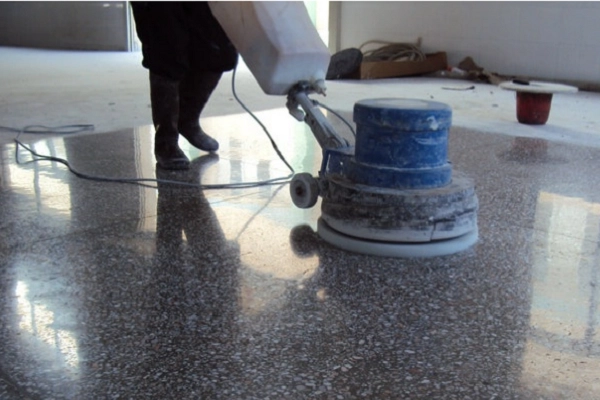
04 Grinding surface
The start time of grinding terrazzo will affect the strength of the cement slurry, which is related to the working environment temperature. The strength of terrazzo grinding should be moderate, and a higher cement slurry strength will result in time-consuming grinding; When the strength does not meet the design requirements, the stone particles will fall off during polishing. When it is at room temperature, the polishing construction can generally begin 2-3 days after the completion of cement slurry construction.
When polishing, the grinding disc should be kept in a water state to flush out the stone slurry. Due to the loose construction of cement stone slurry, slight local pores may appear after the formation of terrazzo, which can be treated by adding slurry.
Terrazzo floors should be polished three times and grouted twice during the polishing process. At room temperature, the first polishing should be carried out 2-3 days after the cement slurry is laid. The first polishing requires the terrazzo floor to be roughly ground flat, and the pattern and shape of the terrazzo should be clearly visible. Any defective areas should be promptly repaired with grout; The second polishing should be carried out 2-3 days after the first polishing is completed, and the polishing should eliminate the scratches, and then repair the local small defects. After 2-3 days, the third grinding is carried out, and the final grinding is the key to the quality of the molding. It is required that the stone particles are evenly exposed, the surface is smooth, and there are no pores, with good visual quality.
Post time: Sep-18-2026